
HOMES · 7 MIN READ
Rooftop solar cost in India (2026): price per kW, subsidy and payback
What a 1, 3, 5 and 10 kW rooftop solar system really costs in India, what drives the price, and how quickly it pays back after the PM Surya Ghar subsidy.
By GR Enterprises Engineering Team ·
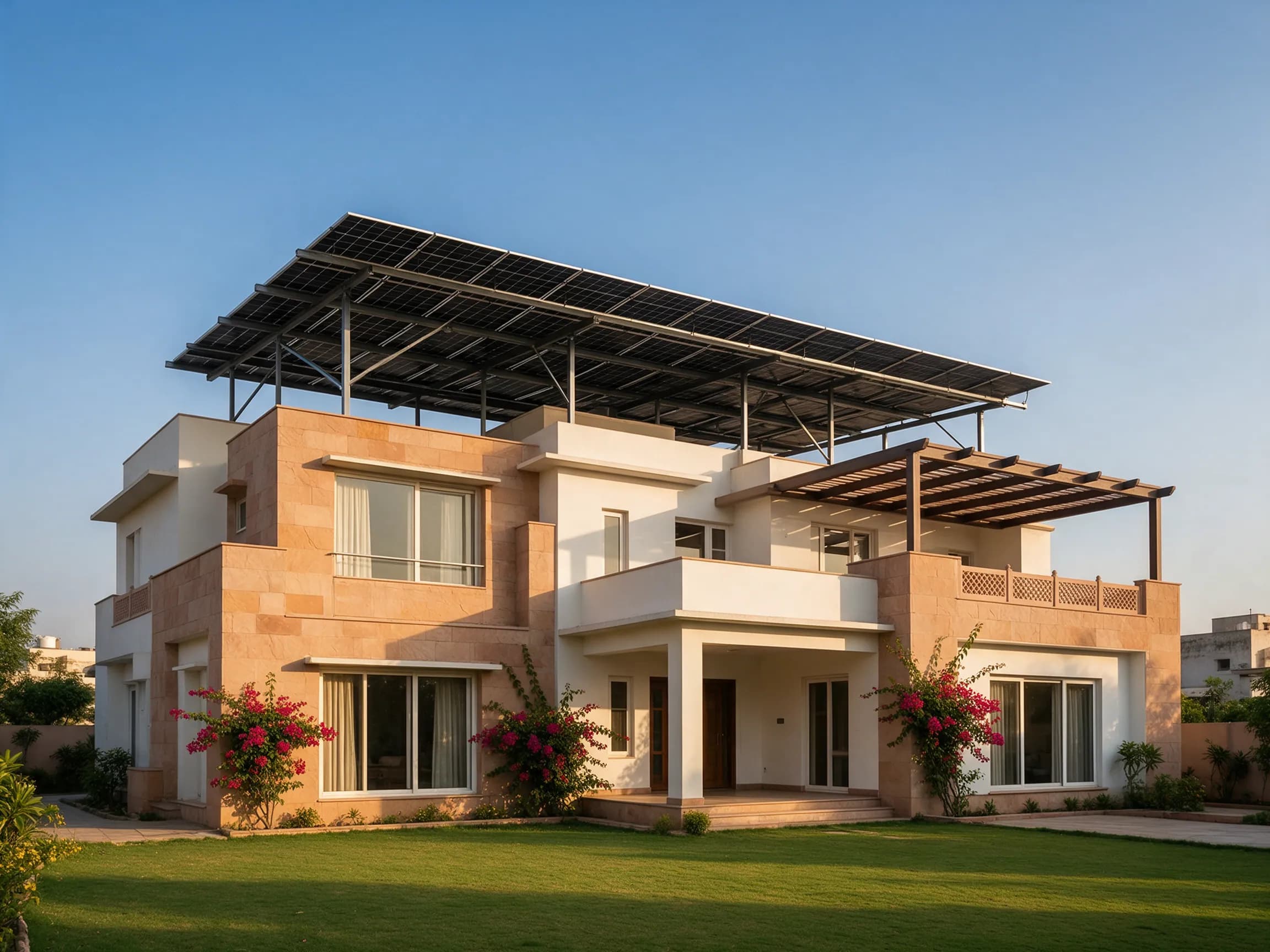
If you are pricing rooftop solar for your home, quotes can vary wildly, from ₹45,000 to ₹80,000 per kW. This guide explains what a fair price looks like in 2026, what you actually get for the money, and how the government subsidy changes the maths.
Typical rooftop solar prices in 2026
For a residential on-grid system with Tier-1 DCR panels, a branded inverter and a galvanised structure, expect the following (before subsidy):
| System size | Typical price range | Monthly generation | Suits a bill of |
|---|---|---|---|
| 1 kW | ₹65,000 – ₹75,000 | 110–130 units | ₹800 – ₹1,500 |
| 2 kW | ₹1.25 – ₹1.45 lakh | 220–260 units | ₹1,500 – ₹2,500 |
| 3 kW | ₹1.8 – ₹2.1 lakh | 330–400 units | ₹2,500 – ₹4,000 |
| 5 kW | ₹2.9 – ₹3.4 lakh | 550–650 units | ₹4,000 – ₹6,500 |
| 10 kW | ₹5.6 – ₹6.4 lakh | 1,100–1,300 units | ₹8,000 + |
Per-kW cost falls as systems get larger, because fixed costs like design, paperwork, the net-meter and labour are spread over more capacity.
How the PM Surya Ghar subsidy changes the price
Under PM Surya Ghar: Muft Bijli Yojana, homeowners get ₹30,000 per kW for the first 2 kW and ₹18,000 for the third kW, capped at ₹78,000. The subsidy is credited directly to your bank account after commissioning.
So a 3 kW system priced at ₹1.95 lakh effectively costs about ₹1.17 lakh. With savings of roughly ₹2,800 a month, it pays for itself in about 3.5 years, and then keeps generating for another 20+ years.
What drives the price up or down
- Panel technology. TOPCon and bifacial modules cost a little more than mono-PERC, but generate 3–8% more energy over their life.
- Structure height. A standard low-rise mount is cheapest. An elevated structure (7–10 ft) costs more but lets you keep using your terrace.
- Inverter brand and type. Hybrid inverters with battery support cost significantly more than on-grid string inverters.
- Roof type. RCC roofs are simplest. Metal sheet and tile roofs need custom mounting.
- Wiring distance. Long cable runs from the roof to the meter add cost.
Red flags in a cheap quote
- No panel make or model mentioned, only "Tier-1"
- Structure described as "GI" without a thickness or galvanisation spec
- Net-metering and subsidy filing charged as "extra"
- No written generation estimate
- No maintenance commitment after installation
The bottom line
A fair price for a quality 3 kW home system in 2026 is about ₹60,000–₹70,000 per kW before subsidy. Insist on an itemised quote, a written generation estimate and clear service terms. Or use our calculator to see your numbers in 10 seconds.