
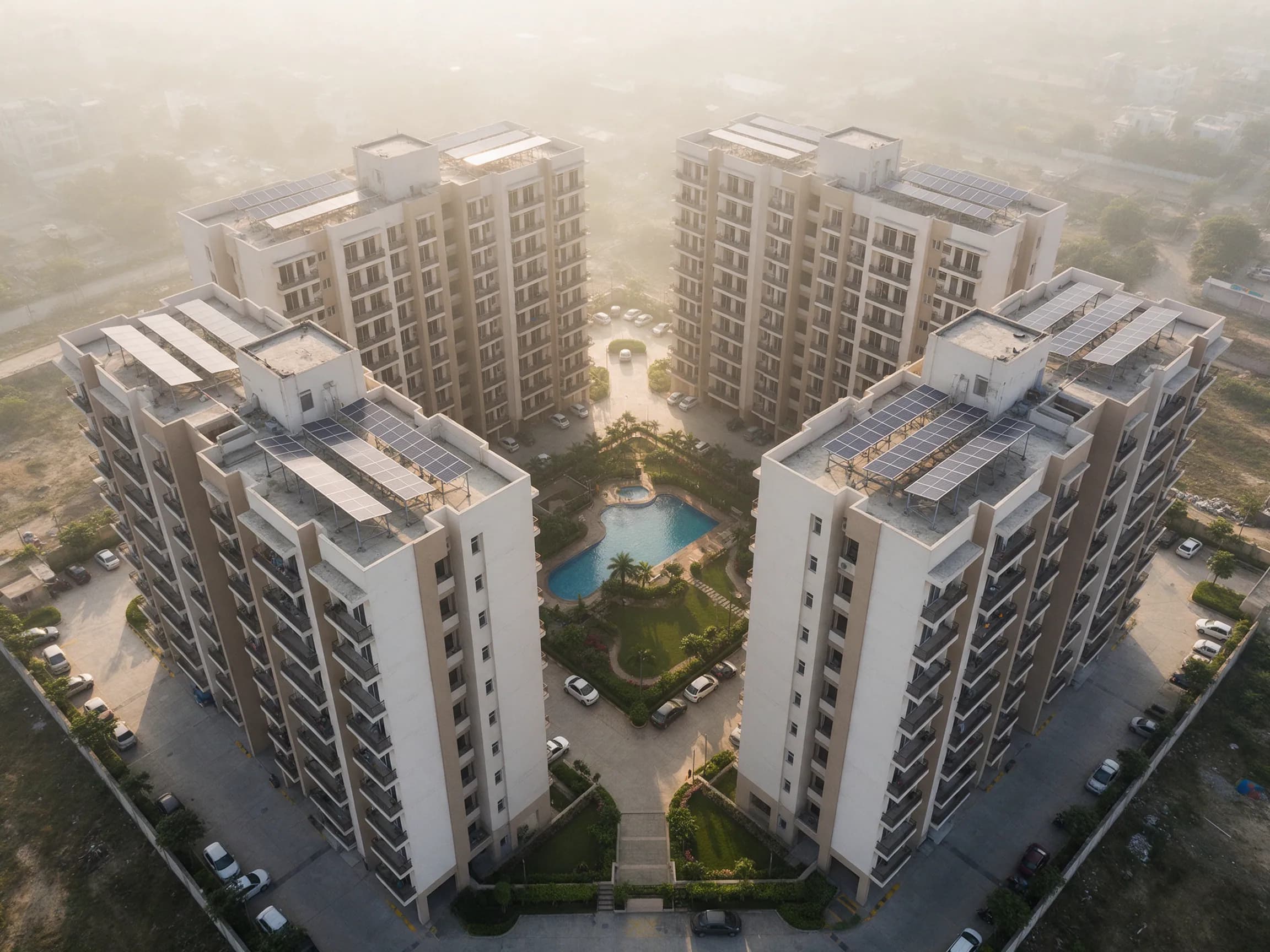
Solar for housing societies · B2C
Lower maintenancefor every flat.
- Common bill cut
- 60–80%
- Subsidy
- ₹18k/kW
- Typical size
- 20–200 kW
Get a proposal for your society
Share your details as a committee member or resident. We'll prepare a proposal for the committee.
What solar powers
Every common load, running on your own roof.
Lifts
Lifts run through the day, which is exactly when solar generates the most.
Water pumps & STP
Pumps and treatment plants are steady daytime loads that solar offsets almost entirely.
Corridor & street lighting
Net-metering credits from daytime generation offset the lighting load at night.
Clubhouse & gym
Air-conditioning and equipment in amenities, at a fraction of the current cost.
EV charging
Add solar-backed EV chargers for residents. We can design both together.
Façade & parking
Solar carports and elevated structures when terrace space is limited.
How it works for societies
From committee approval to commissioning.
- Free terrace survey and load study. We analyse 12 months of common-area bills and check every terrace for shade and structural strength.
- Proposal for the committee. You get a clear document with generation, savings per flat, payback and maintenance terms that you can present at the general body meeting.
- Resolution and approvals. After the GBM resolution, we prepare the DISCOM net-metering application and the subsidy filing for group housing.
- Installation without disruption. Work is scheduled to avoid inconvenience to residents, with full safety barricading on terraces.
- Monthly reports. The committee gets generation and savings reports, and we handle cleaning and maintenance.
Under PM Surya Ghar, Group Housing Societies and RWAs can receive ₹18,000 per kW of central financial assistance for common facilities, including EV charging, up to 500 kW (at 3 kW per house). We confirm current eligibility for your society.
Calculate your 30-year solar savings & subsidy.
Move the slider to match your average monthly power bill and instantly see your recommended system size, subsidy, and lifetime returns.
4.5kW
300 sq ft
Module Count9 × 550 W
- Monthly Power Bill Savings
- ₹4,275
- Estimated Payback Horizon
- 3.5 years
- System Cost (Pre-Subsidy)
- ₹2.55 L
- Central PM Surya Ghar Subsidy
- − ₹78,000
- 30-Year Cumulative Yield
- ₹22.47 L
- 30-Yr CO₂ Footprint Avoided
- 162 tonnes
Verified Customer Reviews
Societies that turned their terraces into savings.
Hear directly from families and commercial proprietors across Haryana who switched to rooftop solar with GR Enterprises and slash their electricity bills by up to 90%.
“A 60 kW plant now runs our lifts, pumps and common lighting. Our common-area bill has fallen by about 70% and the maintenance charge for residents went down this year.”
BILL: ₹1,85,000 → ₹52,00060 kWS Sunrise Heights RWANoida · Housing society
Solar Knowledge Base
Society solar, answered
Clear, transparent answers about PM Surya Ghar central subsidies, DHBVN/UHBVN net-metering approvals, storm-tested mounts, and 30 years performance warranty.
How much does rooftop solar cost in India?
A residential on-grid system typically costs ₹55,000–₹70,000 per kW before subsidy, depending on panel technology, structure height and roof type. After the PM Surya Ghar subsidy, a 3 kW home system usually costs ₹1.1–1.4 lakh. Commercial systems above 50 kW cost less per kW because of scale.
How much can I save with solar?
Most homes cut their electricity bill by 80–95%. A 1 kW system generates about 4–5.5 units a day depending on your city, so a 3 kW system produces roughly 360–480 units a month.
What size of solar system do I need?
Divide your average monthly units (kWh) by 120 to get a rough system size in kW. For example, a home using 360 units a month needs about 3 kW. Our engineer confirms the final size after a free rooftop survey that checks shadow-free area and sanctioned load.
How much roof space is required?
About 80–100 sq ft of shadow-free area per kW. A 3 kW system needs roughly 250–300 sq ft. Elevated structures let you keep using the terrace underneath.
How long does installation take?
Physical installation takes 1–3 days for homes. The full timeline, including design, DISCOM approval and net-meter installation, is usually 3–6 weeks depending on your electricity board.
What happens during a power cut?
An on-grid system shuts down during a grid outage for the safety of line workers. If you need backup, we recommend a hybrid system with batteries that keeps essential loads running.
How long do solar panels last, and what is the warranty?
Tier-1 panels carry a 25–30 year performance warranty, inverters 5–10 years, and our installation workmanship is covered for 5 years. We also offer an annual maintenance plan with cleaning and health checks.
Do you offer EMI or financing?
Yes. We work with banks and NBFCs for solar loans with tenures of up to 5–7 years, often with an EMI lower than your current electricity bill. Ask for the EMI option during your consultation.
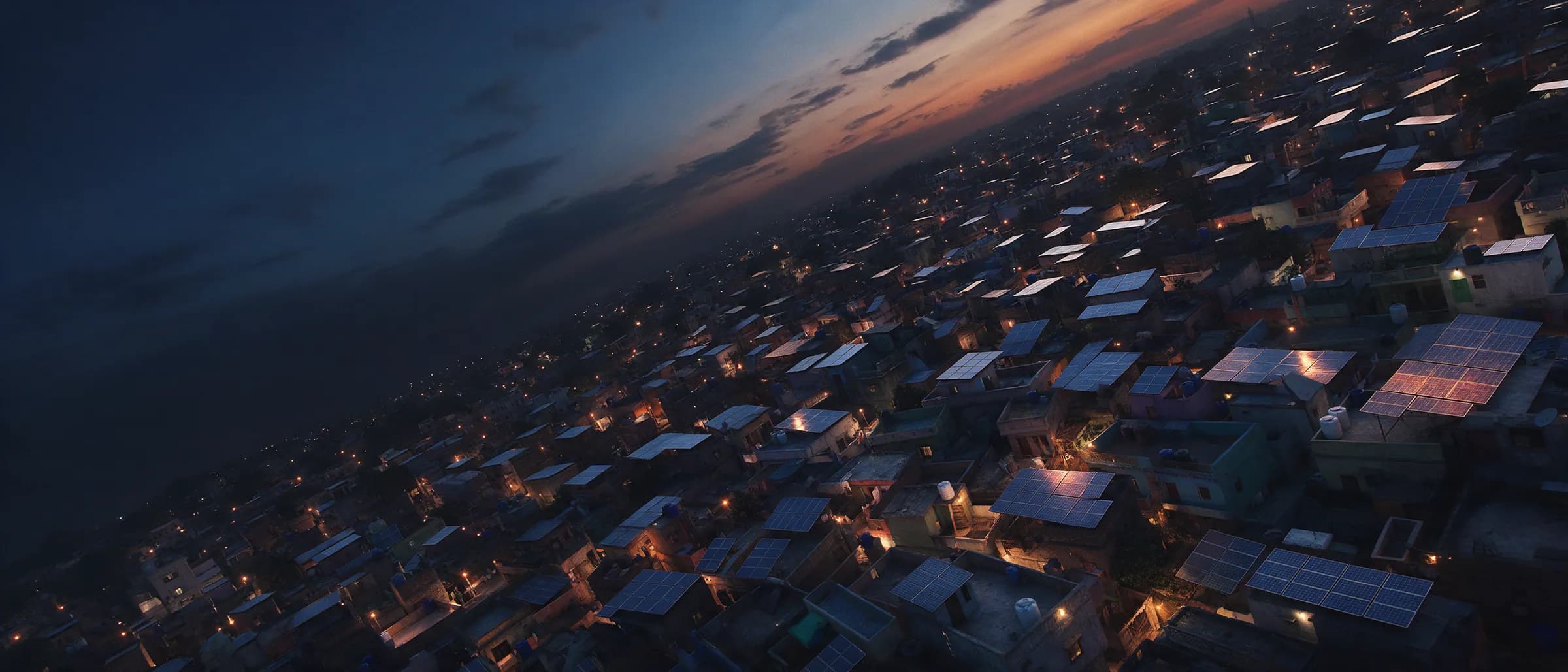
Bring a solar proposal to your next committee meeting.
Our solar engineers will inspect your rooftop, prepare an accurate generation report, and calculate your exact PM Surya Ghar subsidy — with zero sales pressure.
What happens during your site survey?
3-Point Rooftop Inspection Protocol
Free Onsite Rooftop Feasibility Survey
An engineer visits your property to inspect solar irradiance, roof orientation, and usable shadow-free terrace area.
Verified ROI & Generation Report
Transparent monthly generation forecast, Tier-1 equipment specifications, and payback model without hidden markups.
Zero DHBVN / UHBVN Bureaucracy
From submitting net-metering applications to coordinating DISCOM inspections and subsidy release — we manage everything.